Choosing between Less Than Truckload (LTL) and Full Truckload (FTL) shipping is one of the most critical decisions businesses face when managing freight logistics. The wrong choice can lead to wasted budget, delayed deliveries, and operational headaches. In 2026, with freight rates fluctuating and capacity constraints continuing, understanding which shipping method fits your needs has never been more important.
This complete guide breaks down LTL vs FTL shipping, compares costs, and helps you make the right decision for your business. Whether you’re shipping 2 pallets or 20, you’ll learn exactly when to use each method and how to optimize your freight spend.
What is LTL Shipping?
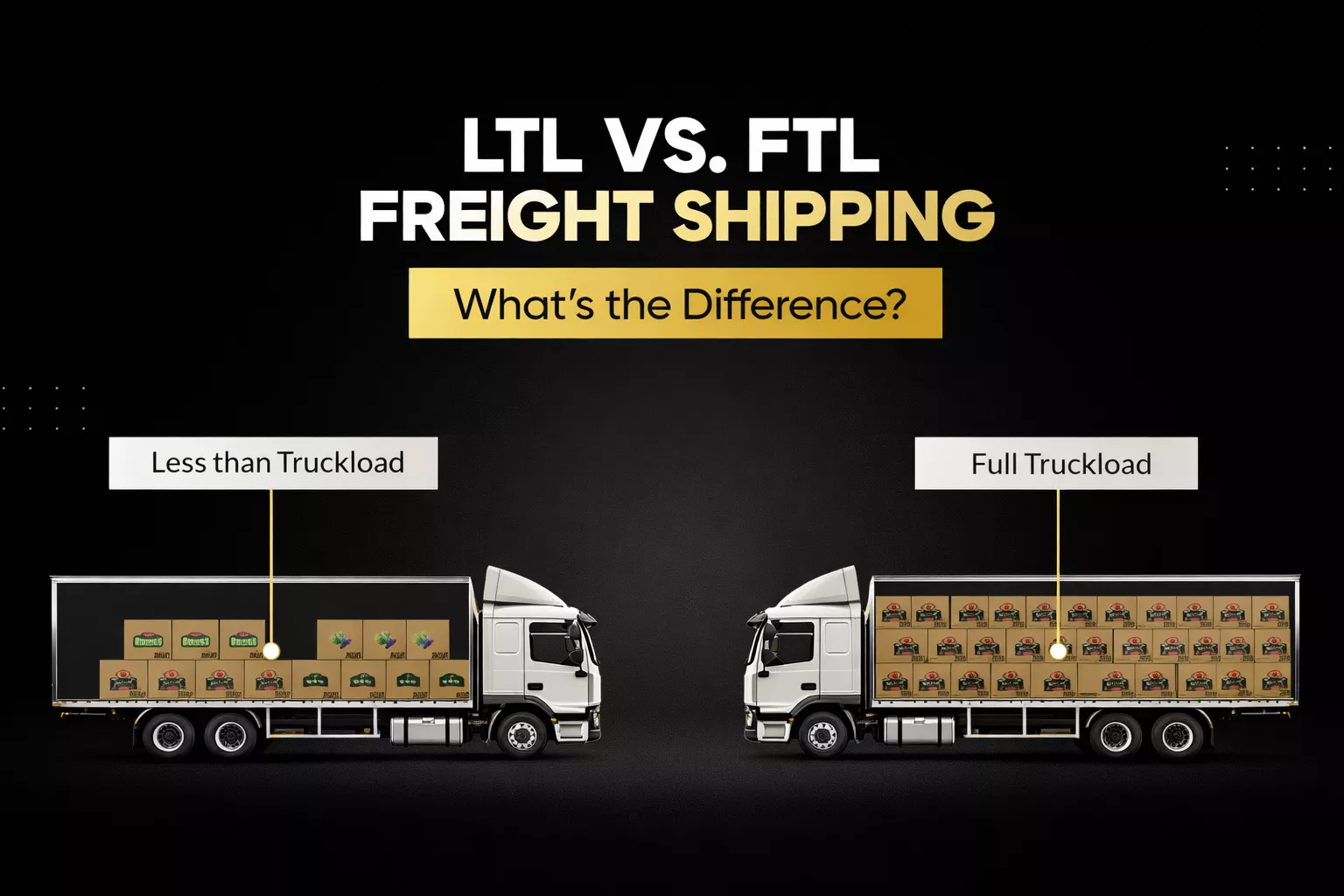
Less Than Truckload (LTL) shipping consolidates freight from multiple shippers into a single truck. Instead of paying for an entire trailer, you only pay for the space your freight occupies. This makes LTL ideal for smaller shipments that don’t require a full truck.
LTL carriers pick up freight from multiple locations, consolidate shipments at terminals, and deliver to various destinations. Your freight shares trailer space with other businesses’ cargo, reducing costs but increasing transit time due to multiple stops.
When to Use LTL Shipping
- Shipments between 150 and 15,000 lbs
- 1-12 pallets of freight
- Non-urgent deliveries with flexible timelines
- Budget-conscious shipping where cost matters more than speed
- Regular smaller shipments to multiple locations
What is FTL Shipping?
Full Truckload (FTL) shipping dedicates an entire truck exclusively to your freight. Your shipment is the only cargo from origin to destination, providing faster transit times, enhanced security, and no handling at intermediate terminals.
FTL trucks travel directly from pickup to delivery without stops at consolidation centers. This direct routing reduces transit time significantly and minimizes the risk of damage since your freight isn’t being loaded, unloaded, and reloaded multiple times.
When to Use FTL Shipping
- Shipments over 15,000 lbs or 12+ pallets
- Time-sensitive deliveries requiring fast transit
- High-value or fragile freight needing minimal handling
- Freight that fills 70% or more of a trailer
- Shipments requiring temperature control or special handling
Not Sure Which Shipping Method You Need?
Our logistics experts analyze your freight details and recommend the most cost-effective solution. Get competitive quotes from our network of trusted carriers.
LTL vs FTL Cost Comparison
Cost is typically the deciding factor between LTL and FTL shipping. Understanding how each method is priced helps you choose the most economical option for your specific shipment.
How LTL Pricing Works
LTL rates are calculated based on several factors:
- Freight Class: NMFC classification (50-500) based on density, handling, and liability
- Weight: Total shipment weight in pounds
- Distance: Mileage between origin and destination
- Dimensions: Length, width, and height affect density calculations
- Accessorials: Liftgate, inside delivery, residential pickup/delivery fees
LTL shipments typically cost between $0.50 to $2.50 per mile, but the cost per pound decreases as shipment size increases. A 2,000 lb shipment traveling 1,000 miles might cost $600-$1,200 depending on freight class and accessorials.
How FTL Pricing Works
FTL rates are typically calculated based on:
- Mileage: Total distance from pickup to delivery
- Equipment Type: Dry van, refrigerated, flatbed rates vary
- Market Demand: Current capacity and seasonal fluctuations
- Lane: Popular lanes cost less than rural or remote routes
- Fuel Surcharges: Variable based on current diesel prices
FTL shipments typically range from $1.50 to $3.00 per mile in 2026. A 1,000-mile FTL shipment might cost $1,500-$3,000 depending on equipment type, lane, and market conditions. While the total cost is higher, the cost per pound is much lower for larger shipments.
| Factor | LTL Shipping | FTL Shipping |
|---|---|---|
| Shipment Size | 1-12 pallets or under 15,000 lbs | 12+ pallets or 15,000+ lbs |
| Transit Time | 3-7 business days (multiple stops) | 1-3 business days (direct route) |
| Cost per Mile | $0.50 – $2.50 per mile | $1.50 – $3.00 per mile |
| Handling | Multiple terminal stops and handling | Minimal handling, direct delivery |
| Security | Moderate (shared trailer space) | High (dedicated truck, sealed trailer) |
| Best For | Smaller, non-urgent shipments | Large, time-sensitive freight |
When LTL Makes More Sense
LTL shipping is the smarter financial choice when your freight doesn’t justify the cost of an entire truck. Here’s when LTL wins:
1. Smaller Shipment Volumes
If your freight occupies less than 60% of a trailer’s capacity, you’re paying for empty space with FTL. LTL lets you share costs with other shippers, dramatically reducing your expense. A 4-pallet shipment that would cost $2,000 as FTL might only cost $600-$900 via LTL.
2. Flexible Delivery Timelines
When your delivery isn’t urgent and can accommodate 5-7 business days, LTL’s longer transit time isn’t a problem. Manufacturing components, retail inventory replenishment, and routine supply shipments often have flexible schedules that work perfectly with LTL routing.
3. Budget Constraints
Startups, small businesses, and companies shipping non-urgent materials benefit most from LTL’s cost savings. The ability to ship smaller quantities more frequently helps manage cash flow and reduce inventory holding costs.
4. Multiple Pickup or Delivery Points
LTL carriers already make multiple stops, so adding extra pickup or delivery locations doesn’t significantly increase cost. If you need to consolidate freight from 2-3 suppliers or deliver to multiple distribution centers, LTL provides built-in route flexibility.
Need Help Finding the Right LTL Carrier?
We connect you with pre-vetted LTL carriers offering competitive rates and reliable service. Get instant quotes and book your shipment in minutes.
When FTL Makes More Sense
Full Truckload shipping becomes the better option when speed, security, or shipment size justify the higher base cost. Here’s when FTL is worth the investment:
1. Large Shipment Volumes
Once your freight exceeds 12-15 pallets or 15,000 lbs, FTL often becomes cheaper per pound than LTL. You’re paying for the entire truck anyway, so maximizing trailer capacity delivers the best value. A 20,000 lb shipment costs roughly the same as a 40,000 lb shipment via FTL.
2. Time-Critical Deliveries
When production schedules, customer commitments, or seasonal deadlines create urgency, FTL’s direct routing delivers 2-4 days faster than LTL. Just-in-time manufacturing, event materials, and emergency stock replenishment require FTL’s speed to avoid costly delays.
3. Fragile or High-Value Freight
Electronics, machinery, pharmaceuticals, and other valuable cargo benefit from FTL’s minimal handling. Your freight loads once at origin and unloads once at destination, eliminating the damage risk from multiple terminal transfers. The dedicated trailer also provides better security against theft or tampering.
4. Temperature-Controlled or Special Requirements
Refrigerated freight, hazmat materials, and shipments requiring specific handling are easier to manage with FTL. You control the entire trailer environment and can specify exact requirements without coordinating with other shippers’ needs.
The Break-Even Point: When to Switch from LTL to FTL
The crossover point where FTL becomes more economical than LTL depends on several factors, but general guidelines help you make the decision:
Weight and Space Thresholds
- Under 10,000 lbs: LTL almost always cheaper
- 10,000 – 15,000 lbs: Compare quotes; could go either way
- Over 15,000 lbs: FTL typically more economical
- Over 12 pallets: FTL usually wins regardless of weight
Distance Considerations
Distance impacts the break-even calculation. Longer distances favor FTL because:
- FTL per-mile rates decrease with distance
- LTL requires more terminal stops over long hauls
- Time savings become more significant on cross-country routes
- Damage risk increases with more LTL handling on long distances
A 500-mile shipment might favor LTL at 8,000 lbs, while the same weight shipment traveling 2,000 miles could be cheaper via FTL due to long-distance FTL discounts.
Hybrid Options: Volume LTL and Partial Truckload
Sometimes your shipment falls into the gray area between LTL and FTL. Two hybrid options provide middle-ground solutions:
Volume LTL
Volume LTL (also called volume truckload) handles shipments between 6-12 pallets or 5,000-12,000 lbs. You get discounted LTL rates because your freight occupies significant trailer space, but you still share the truck with other shippers. Volume LTL typically offers:
- 30-50% lower rates than standard LTL
- Faster transit than regular LTL (fewer consolidation stops)
- More economical than FTL for mid-size shipments
- Priority handling at terminals
Partial Truckload
Partial truckload dedicates a portion of a trailer to your freight, with only 1-2 other shipments sharing space. You get many FTL benefits—faster transit, less handling—at a lower cost. Partial truckload works well when:
- Your freight is 8-16 pallets (between LTL and FTL thresholds)
- You need faster delivery than LTL but can’t justify FTL cost
- Your route is popular (carriers easily find compatible loads)
- You want dedicated space without paying for an empty trailer
Let Us Find the Perfect Freight Solution
Whether you need LTL, FTL, or something in between, our logistics team compares options across our carrier network to find the best rate and service for your specific shipment.
How to Choose: Decision Framework
Use this simple decision framework to determine the right shipping method for your freight:
Step 1: Calculate Your Freight Density
Measure your freight’s dimensions (length × width × height in inches) and weight in pounds. Calculate density: (Weight ÷ Cubic Inches) × 1,728. Higher density usually means lower freight class and better LTL rates.
Step 2: Assess Shipment Size
- Under 6 pallets or 5,000 lbs → Start with LTL quotes
- 6-12 pallets or 5,000-15,000 lbs → Compare LTL, volume LTL, and partial truckload
- Over 12 pallets or 15,000 lbs → Get FTL quotes
Step 3: Evaluate Time Sensitivity
If your delivery deadline is tight (within 3-5 days), FTL’s direct routing is often necessary. Flexible timelines (7+ days) allow LTL cost savings without risking late delivery.
Step 4: Consider Freight Value and Fragility
High-value or fragile goods (electronics, machinery, glassware) benefit from FTL’s minimal handling, even if the shipment is smaller. The reduced damage risk often justifies the higher cost.
Common Mistakes to Avoid
1. Choosing LTL for Heavy, Dense Freight
Heavy, compact freight (machinery, steel, building materials) often has unfavorable freight class, making LTL surprisingly expensive. Even at 8,000 lbs, dense freight might cost more via LTL than FTL due to high freight class multipliers.
2. Not Factoring in Accessorial Charges
LTL quotes often exclude accessorial fees that can add 20-40% to your total cost. Liftgate service ($75-$150), inside delivery ($75-$200), residential pickup/delivery ($85-$200), and limited access fees quickly erode LTL’s cost advantage.
3. Ignoring Transit Time Requirements
Businesses often choose LTL for cost savings without considering whether the 5-7 day transit meets their deadline. Rush orders, seasonal inventory, and just-in-time manufacturing can’t tolerate LTL delays, making FTL’s premium worth paying.
4. Inaccurate Measurements and Weight
Underestimating dimensions or weight leads to reweigh/reclassification fees that can double your LTL cost. Always measure carefully and add packaging weight to your calculations. Carriers will reclassify your freight if discrepancies are found.
Frequently Asked Questions
Can I ship a single pallet via FTL?
Technically yes, but it’s rarely cost-effective. You’ll pay for an entire truck even though you’re only using a small fraction of the space. LTL is designed for single-pallet shipments and will cost significantly less unless your freight requires FTL’s speed or security.
How much faster is FTL than LTL?
FTL typically delivers 2-4 days faster than LTL for the same route. A 1,000-mile FTL shipment might take 2 days, while LTL could take 5-7 days due to terminal stops, consolidation, and deconsolidation processes.
What happens if my LTL shipment is damaged?
File a freight claim with the carrier within their specified timeframe (usually 9 months). Document damage with photos at delivery and note it on the delivery receipt. Carriers provide basic liability coverage, but consider purchasing additional freight insurance for valuable cargo.
Can I convert an LTL shipment to FTL after booking?
Possibly, but it depends on timing and carrier availability. If your freight hasn’t been picked up yet, contact your logistics provider immediately to discuss options. Once freight enters the LTL network, conversion becomes difficult and may incur cancellation fees.
Do freight brokers offer better LTL and FTL rates than direct carriers?
Yes, brokers typically access negotiated volume discounts across multiple carriers, often securing rates 10-25% lower than what individual shippers can negotiate directly. Brokers also provide carrier comparison, route optimization, and claims assistance as part of their service.
Ready to Ship? Get Competitive Freight Quotes Today
Whether you need LTL for small shipments or FTL for large freight, Goldnova Logistics connects you with trusted carriers offering the best rates and service. Our team analyzes your freight details and provides transparent quotes within 1 hour.
Tagged with :